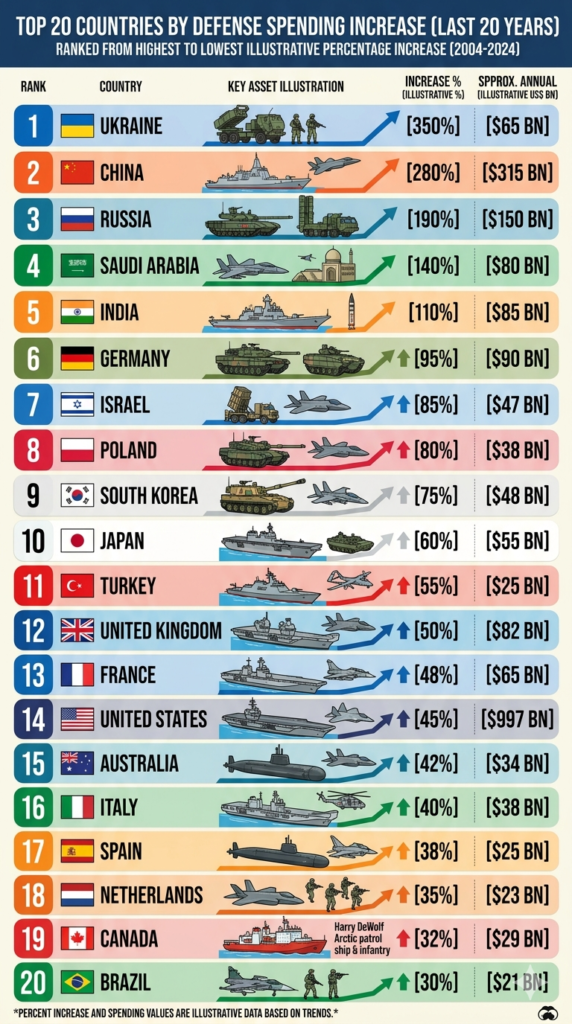
Global military spending has shattered records, surpassing $2.4 trillion in 2026 for the first time in history. From superpowers racing to modernize nuclear arsenals to smaller nations quietly doubling their defense budgets, the world is arming up at a pace not seen since the Cold War. Geopolitical tensions, regional conflicts, and the rise of AI-powered warfare have pushed governments to open their checkbooks wider than ever — and the numbers are staggering.
But who’s actually writing the biggest checks? The answer reveals more than just military muscle — it exposes shifting global power, rising threats, and the nations betting their futures on firepower. Whether it’s a Pacific giant quietly building the world’s largest navy, a European economy making up for decades of underinvestment, or a Middle Eastern kingdom turning oil wealth into warplanes, this ranked list tells the story of a world on edge. Here are the 20 countries spending the most on defense in 2026.
🇺🇸 United States — $997 Billion
The US spends more on defense than the next 10 countries combined.
🇨🇳 China — $315 Billion
China’s defense budget has grown 600% since the year 2000.
🇷🇺 Russia — $150 Billion
Russia spends 6.2% of its entire GDP on military — the highest ratio in Europe.
🇮🇳 India — $85 Billion
India is the world’s largest arms importer despite having its own defense industry.
🇸🇦 Saudi Arabia — $80 Billion
Saudi Arabia spends more per soldier than any other nation on Earth.
🇬🇧 United Kingdom — $82 Billion
The UK maintains one of only 5 nuclear arsenals in NATO.
🇩🇪 Germany — $90 Billion
Germany was spending below NATO’s 2% GDP target as recently as 2021.
🇫🇷 France — $65 Billion
France is the only EU member with a permanent UN Security Council seat and nuclear weapons.
🇯🇵 Japan — $55 Billion
Japan’s constitution once banned offensive military capability — that is now changing fast.
🇰🇷 South Korea — $48 Billion
South Korea has mandatory military service for all men with a minimum of 18 months.
🇮🇱 Israel — $47 Billion
Israel’s Iron Dome has intercepted over 90% of incoming rockets since deployment.
🇺🇦 Ukraine — $65 Billion
Ukraine’s defense budget increased by over 300% since the 2022 Russian invasion.
🇦🇺 Australia — $34 Billion
Australia signed the AUKUS deal to acquire nuclear-powered submarines — a first for the nation.
🇵🇱 Poland — $38 Billion
Poland now spends 4% of GDP on defense — the highest ratio in all of NATO.
🇹🇷 Turkey — $25 Billion
Turkey produces its own armed drones — the Bayraktar TB2 — now exported to 30 plus countries.
🇳🇱 Netherlands — $23 Billion
The Netherlands quietly operates one of NATO’s most advanced cyber warfare units.
🇪🇸 Spain — $25 Billion
Spain only recently crossed NATO’s 2% GDP spending threshold after years of pressure.
🇨🇦 Canada — $29 Billion
Canada has faced repeated criticism from US presidents for underspending on NATO commitments.
🇮🇹 Italy — $38 Billion
Italy is home to more US military bases than any other country in Europe.
🇧🇷 Brazil — $21 Billion
Brazil has the largest military in Latin America with over 360,000 active personnel.
Key Takeaway 1 — The US is in a league of its own
America’s $997 billion budget is bigger than the next 10 countries on this list combined. No nation comes close and with AI weapons programs accelerating that gap is not closing anytime soon.
Key Takeaway 2 — Europe is rearming at historic speed
Germany, Poland, the Netherlands and others have dramatically increased spending since Russia’s invasion of Ukraine. Poland spending 4% of GDP on defense is a number that would have been unthinkable in 2019. The era of European complacency is officially over.
Key Takeaway 3 — Asia is the fastest growing military region on the planet
China, India, Japan, South Korea and Australia are all increasing budgets simultaneously. The Pacific is quietly becoming the most militarized region on Earth and the competition between China and its neighbors is only heating up.
The world’s military spending map in 2026 tells a clear story — global tensions are rising and no major nation is betting on peace alone. From Washington to Beijing, Berlin to Warsaw, governments are investing in firepower at a generational scale. Whether this arms buildup makes the world safer through deterrence or more dangerous through escalation is the defining question of our era. One thing is certain: the wallets are open and the weapons are coming.